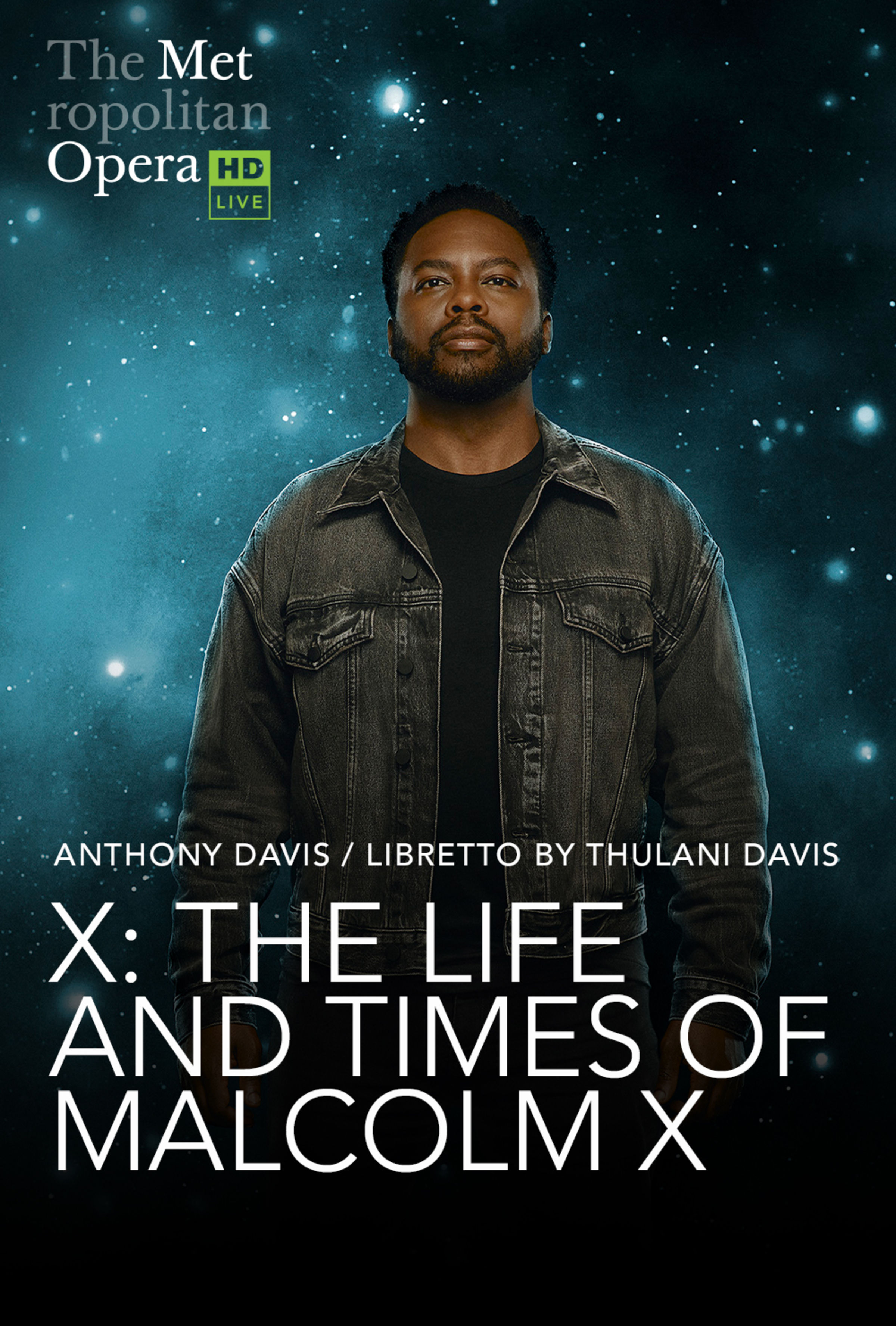
Anthony Davis’s, X: The Life and Times of Malcolm X, has officially returned in its recent restaged debut at the New York City Metropolitan Opera. The 3 hour and 20-minute long performance takes audiences through 3 acts and 12 vignettes illustrating the life of Malcolm X; and while it certainly follows the paths laid by Alex Haley and himself through his 1965 autobiography, it focuses on the activist’s triumphs and evolutions/transformations rather than the pivotal moments of crisis and personality.
Similarly to Spike Lee’s X, X: The Life and Times of Malcolm X provides Malcolm X’s story with the grandness, respect, and recognition it deserves. The Opera is not only focused on a black story and a black composer but also features an all-black cast. This deliberate choice follows suit of Spike Lee’s X, where the emphasis on no grandeur sparred highlights the recognition Malcolm X’s story deserved.
The ~unusual~ opera follows the Afrofuturist genre with the story’s premise being that “a spaceship has crashed into the Met, and a future race of people are telling the story of this icon,”. There they tell the story of, what to me seemed to be more about, his legacy rather than civil rights itself. Still, the opera illustrates Malcolm X from his youth to his death, from Lansing, Boston, Mecca, Harlem, and of course, the place of assassination, the Audubon Ballroom.
The narrative is joined by a score that, like X himself, is strong, complex, and compelling with a wide range of inspiration from African dance rhythms, South Indian Drums, Black dance music, etc., and an overall tone reminiscent of Miles Davis’ Bitches Brew. To me- the score felt like a more integral part of the performance than the singing itself. The deliberate choice to include types of music essential not only to black culture but also to Malcolm’s life vision and goals further emphasizes his preachings on the treatment of their humanity and culture. The white man has appropriated the Black man's culture, specifically music far too long. However, having The Metropolitan Opera, restage not only an all-black cast performance but also an afro-futurist score illustrates the contemporary times that have finally, at least in some ways, changed and given the spotlight that black artistry and the impact it deserves.
While this was my first opera (making me a rather unqualified critic), I thoroughly enjoyed the show. The music was captivating in tandem with the power of the all-black cast, and beautifully composed choreography. Kudos to the actor who played young Malcolm, whose role in the first act shined with bravery and courage, unfortunately somewhat outshining the lead himself. To me- the strongest performers were not Older Malcolm, but younger Malcolm, Louise, Betty, Ella, and Elijah Muhammad. Despite his wonderful performance, I felt as though Old Malcolm was overshown by the talent of his co-stars. Which did not reduce the significance and success of the performance, but was somewhat disappointing I am one to talk. Still, by the end of the show, while pleased and content, I couldn’t help but think that the show was more about his legacy than his personality and civil rights impacts themselves. As Kurt Gottschalk said, “Someone walking into the opera without knowledge of the man born in 1925 as Malcolm Little and assassinated in 1969, having taken the Muslim name el-Hajj Malik el-Shabazz, would leave not understanding his mark on racial politics in America”.
The opera’s portrayal of the changing his approach to civil rights and activism throughout his life emphasizes that while sometimes thought of as a prophet, he was just a man. A man who wanted to reclaim his humanity, and thanks to Anthony Davis he can. X: The Life of Malcolm X seeks to invite viewers all over the U.S. to reflect on his legacy and its connections to the modern civil rights issues we face today.


No comments:
Post a Comment